


Lake County
History and Legends informing The Spider Passage
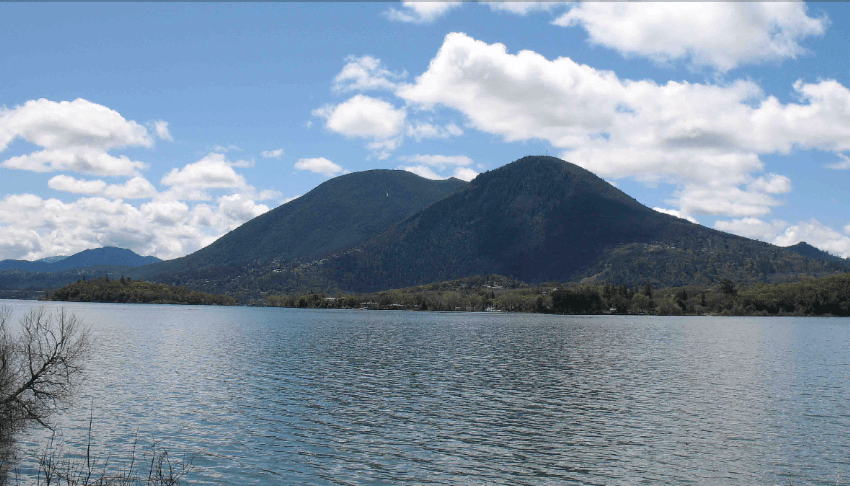
Mount Konocti
Legends of caverns beneath Mount Konocti have long been part of local lore. To date, no such caverns have been discovered in modern times. Their presence in this story belongs to the realm of imagination and myth.
The Bloody Island Massacre
If you were the descendant of a white settler, you might read an account of the Bloody Island "battle" at the Lake County Historical Society. If you were Native, you might hear about the massacre from your grandparents. Eventually someone wrote down the spoken story and included it in the annals of the Lucy Moore Foundation, an organization founded by Lucy's grandson, Clayton Duncan, in honor of his grandmother, a survivor of Bloody Island.
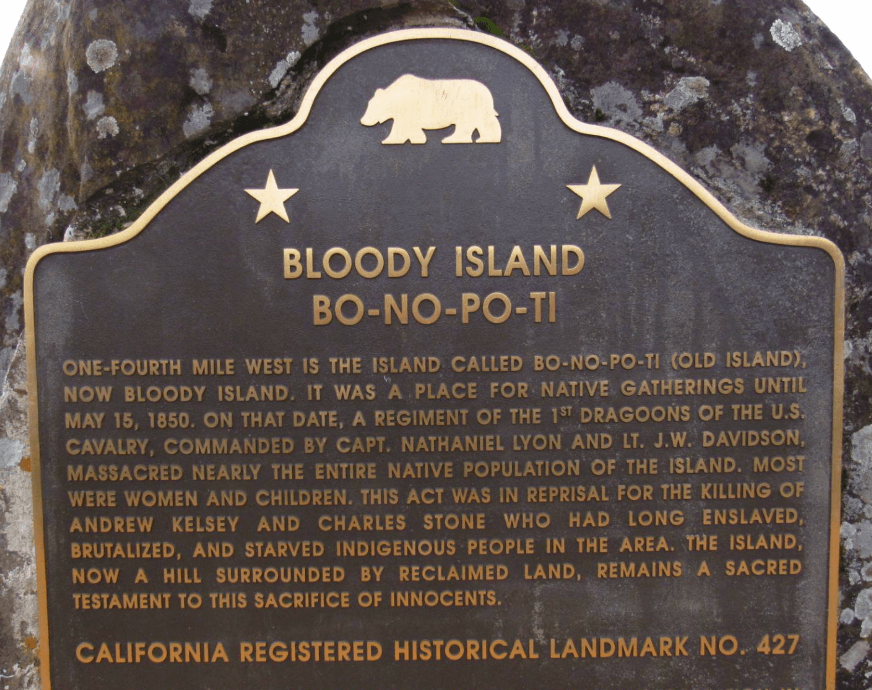
Both accounts would offer the same basic facts. Kelsey and Stone were cruel, depraved men. They starved and beat the Pomo. A group of Pomo, in retribution, attacked and killed them. In response, local white settlers called on the US government for help with what they called "the Indian problem." The US Army, under the leadership of Nathaniel Lyon, shot and killed unarmed men, women, and children by shooting cannons and rifles from a bluff near Upper Lake toward Badonnapoti, an island now known as Bloody Island. from boats, soldiers forced those on the island into a surprise ambush, killed them, and searched the surrounding tules until they believed they had killed every last one.
Beyond these basic facts, the stories diverge sharply. In the white man's version, the Natives were "punished" for their brazen attack. Kelsey and Stone were cruel, yes, but only because the Indians were lazy and didn't want to work. In some of these accounts, Native males were called bucks, as if they were wild elk, not men.
The Pomo version told a very different story. Kelsey and Stone raped the women, molested children, and enforced all manner of cruelty in the subjugation of tribal peoples, enslaving the people, treating them as subhuman, and working them to near death. When they retaliated, the Cavalry was called. The government attacked a group of peaceful people who had nothing to do with the killing of Kelsey and Stone, and they slaughtered them. The massacre did not stop at Bloody Island; it continued as official government-financed "expeditions" that were dispatched to seek out and kill any Native living in the hills or mountains near Clear Lake. Only those who hid well or were somehow protected survived.
A survivor of the Bloody Island massacre, and eyewitness to it, was Lucy Moore. The child survived by hiding underwater, breathing through a reed, as her grandmother had taught her, until long after the Army left. By her account, the soldiers killed everyone, even babies, spearing them with bayonets. The waters of Clear Lake turned red with the blood of the people that fateful day.
Wailing, sadness, and deep rage passed to the descendants of Lucy and those slaughtered at that massacre and others to follow. Many years later, Clayton Duncan, weary of carrying the anger, offered a forgiveness ceremony. A handful of both Native and non-Native people attended, and these grew in number over the years.
Official Apologies and Actions
Duncan asked and waited for an official apology from the federal government, an apology that came in the form of a rider on an appropriations bill, H.R. 3326, Department of Defense Appropriations Act, 2010:
“(Sec. 8113) States that the United States, acting through Congress: (1) recognizes that there have been years of official depredations, ill-conceived policies, and the breaking of covenants by the federal government regarding Indian tribes; (2) apologizes on behalf of the people of the United States to all Native Peoples for the many instances of violence, maltreatment, and neglect inflicted upon them by U.S. citizens; (3) urges the President to acknowledge such wrongs; and (4) commends state governments that have begun reconciliation efforts and encourages all state governments to work toward reconciling their relationships with Indian tribes within their boundaries. States that nothing in this section authorizes or supports any claim, or serves as a settlement of a claim, against the United States.”
The state of California issued an apology to all California Indians in 2019, mentioning the massacres and "expeditions" between 1850 and 1859 specifically. They failed to mention, however, that these massacres solved "the Indian Problem," which had stood between California and statehood in the time leading up to the Civil War.
Renaming Kelseyville
In October 2023, a group of (mostly non-Native) citizens, without consultation with or an official request from the tribal governments, petitioned the United States Board of Geographic Names (BGN) to change the name of the town of Kelseyville. This ignited local pushback in the form of "Save Kelseyville" lawn signs, accompanied by "just get over it" and "white guilt" accusations on social media. Many avoided the racism conversation altogether by citing community pride and the cost of such a change to local businesses, even though no business would be required to change its name.
The Board of Supervisors placed an advisory measure on the ballot in November 2024. This was known as Measure U.
"I want the opportunity for the Indigenous people that have been here forever to see where we stand in this county. Every vote that we've taken, I think I know the outcome already. But I want it on the record," said District 1 Supervisor Simon, chair of Middletown Rancheria and one of two tribal members on the board at the July meeting. "Let's see how racist we really are." He made it clear that regardless of the ballot result, he would support the name change.
On November 5, 2024, citizens of Lake County voted on that advisory ballot measure. Over 70 percent of the population voted against changing the name of "Kelseyville" to "Konocti." Still, the relatively low-key campaign rhetoric (by Lake County standards) offered some hope—perhaps an indication that the community might be ready for the difficult process of reconciliation and healing.
On December 10, 2024, the Lake County Board of Supervisors voted 3-2 to recommend the name change to the BGN. Lake County News Reported on December 11, 2024.*
District 1 Supervisor Simon, who also is chair of Middletown Rancheria and one of two tribal members on the board. Simon made it clear when he voted to have the advisory measure back in July that regardless of the ballot result, he would support the name change.
“I want the opportunity for the Indigenous people that have been here forever to see where we stand in this county. Every vote that we’ve taken, I think I know the outcome already. But I want it on the record. I want it on the record,” said Simon at the July meeting. “It’s on the record now. No running away from it. I got what I wanted,” said Simon before voting for the name change on Tuesday.
Supervisor Crandell, another tribal member on the board, supported the name change and brought up the fact that the name change was “unanimously supported” by the National Congress of American Indians, which consists of 574 federally-recognized tribes in the nation.
…
While he felt that it was “a lack of due diligence” and frustrating, “at the same time, I know that there was an intent to do good and to try and do something moral.”
Even today, Lake County has yet to come to terms with what happened at Badonnapoti in 1850. But in the words of Supervisor Moke Simon: “Change the name, the healing can start.”
